
Built Local with Kurtzon Lighting
It Began with Organized Labor
Before he was a manufacturer, Morris Kurtzon was a tradesman. Born in Lithuania in 1875, he came to the United States alone at age eleven and went to work. By 1890 he had been elected Vice President of the Chicago Platers Union. He started his own plating operation in the basement of his apartment building with a cousin, Marcus Udwin, then brought in his brother George. In 1898 the two founded Garden City Plating & Manufacturing, known as GARCY, plating hardware for bicycles, sewing machines, stoves, and bathrooms.
Every Kurtzon luminaire today is still made in America and proudly union made by IBEW Local 134 members in Chicago, an unbroken line from the founder’s own union card to the plant floor at Talman Avenue.
Historical Building Significance
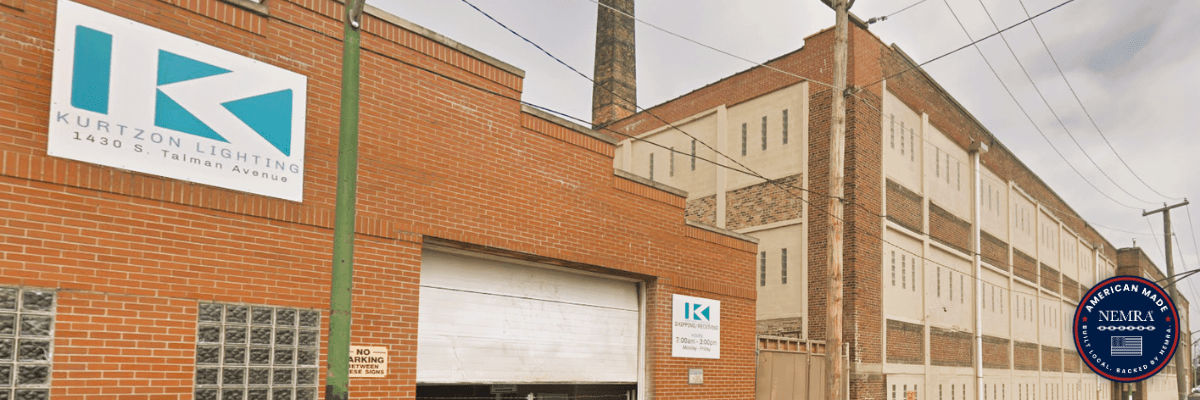
The factory at 1420 South Talman Avenue carries genuine architectural significance. The southern half was completed in 1910 and the northern half after World War I. Original blueprints held in the company archives name Schmidt, Garden & Martin as the design architects, an important member firm of the Chicago Architecture Club. The building has been identified as a classic example of the Chicago School of Architecture, the indigenous movement by which architects sought to develop a style completely American. Kurtzon has maintained and operated that building continuously for more than a century rather than relocating to a suburban or offshore facility. Today it houses engineering, fabrication, assembly, quality control, and administration under one roof.
The Founding of Mount Sinai Hospital
Kurtzon’s largest local investment was never a product. Morris Kurtzon set out to give the West Side community a hospital where Jewish physicians could practice without prejudicial exclusion. Using his own money, he bought the bankrupt Maimonides Hospital and reorganized it as the Mount Sinai Hospital Association in 1919. He then refused an attractive offer to sell the property to the University of Illinois, preferring instead to donate it to the entire community as beneficiary. The community answered with a broad fundraising effort, and Mount Sinai’s early history included a notably strong presence of women among its supporters at a time when that was uncommon.
He devoted years to planning and designing the facility, served as its president from its inception in 1919 through 1945. He watched it earn certification as a teaching hospital and open new wings, including nurse training for contagions that proved its worth during the influenza epidemic. GARCY designed and built custom equipment for the hospital, much of it stainless steel, and that work is the direct ancestor of the stainless-steel technical lighting Kurtzon is known for today. In 1956 the medical staff of Mount Sinai presented Morris Kurtzon a testimonial honoring his efforts for the betterment of the Chicago community as a whole.
Lighting the Institutions That Built the City
Kurtzon’s work is embedded in Chicago’s public infrastructure. In 1950 the Chicago Transit Authority commissioned the company to design and fabricate a corner mounted cornice fluorescent fixture for the public stairwells of its Loop stations, a decision driven by Kurtzon’s stainless steel fabrication expertise. In 1985 Kurtzon won the bid to produce lighting for O’Hare International Airport. In 2010 the complete range of Kurtzon technical medical products was selected for Rush University Medical Center. Company engineering records from the 1960s show sustained attention to Chicago hospital projects, including custom fixtures built to filter radio frequency interference in operating rooms. In 1956 the company was also approved to fabricate a Frank Lloyd Wright fixture design for the H.C. Price Building.
National Service from a Chicago Floor
When the country called, the work was done here. During World War I the government asked GARCY to produce 20 mm shell casings, which required Morris to redesign much of the plant’s equipment and tooling. In World War II the War Department returned, and the company produced airfield wind indicators in lots of 1,500 for delivery within three months of each released order, some built in a company garage at 4200 Lincoln Avenue, along with subcontracted supercharger components for the P‑47 Thunderbolt fighter.
Four Generations, One Family, One City
GARCY was dissolved in 1948 and reorganized as Morris Kurtzon, Inc. Morris’ son-in-law, Army veteran Captain David Koch, joined the company and steered it toward the fluorescent lamp technology that emerged from the war. Following the passing of the founding partners between 1959 and 1961, David Koch became president in 1965, and when he retired, his son Dan Koch took over. The company remains family owned and operated today, led from the same Talman Avenue plant by Dan’s son, Andrew Koch. The industry firsts have continued from that address: the first recessed Round Dome in 1957, the first sealed and gasketed recessed fixtures in 1968, the Haz‑Lock Class I Division 2 hazardous location fixture in 1976 that was later used by NASA, the first UL and NSF dual listed kitchen hood fixtures in 1978, the first complete stainless steel clean space line in 1980, and the first LED darkroom safelight in 2002.